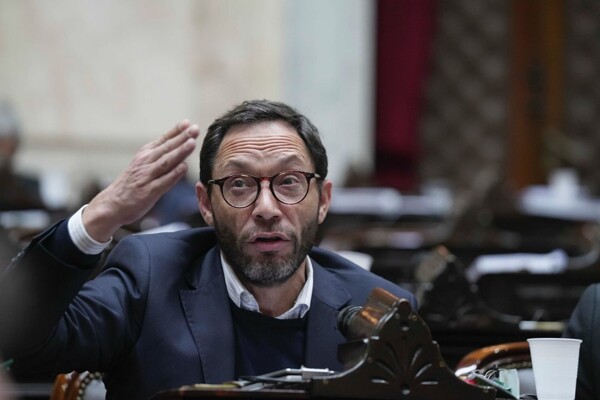
Just one day after formally taking office, Argentina's Minister of Justice, Juan Bautista Mahiques, made his first major move by requesting the resignations of the heads of the main bodies under his ministry. The changes affect the General Inspection of Justice (IGJ), the Financial Information Unit (UIF), and other sensitive areas related to state control, transparency, and asset recovery.
According to sources within the government, the resignation requests cover four of the five bodies under the ministry's jurisdiction: the International Centre for the Promotion of Human Rights (CIPDH), the Office of Anti-Corruption (OA), the Office of Recovered Assets, and the UIF. The request for the resignation of the current leadership suggests that Mahiques intends to impose his own orientation and, above all, to align the UIF's structure with the new political scheme of the ministry.
With Mahiques's arrival, the decision on this case now appears as one of the first tests of strength: the minister inherits a 'hot' case and, at the same time, seeks to show that his ministry will not be a mere 'administrative step,' but a center of political-institutional control. The UIF, for its part, is a critical gear both domestically and internationally. In a country where discussions on financing, patrimonial control, and fund tracing often touch on sensitive interests, the leadership of the UIF is a strategic seat for any administration.
In the government, they justify the changeover as 'logical' and customary with a change in management. Everything indicates that the reorganization is not improvised: it responds to a power design and a roadmap to reorder the ministry from top to bottom. For now, the chain of resignations marks a line: Mahiques wants total control over the areas under his orbit and seeks to avoid 'double commands' in bodies that can condition the government's agenda on transparency, corporate control, and fund tracing.
The political reshuffle at the Ministry of Justice has a background that combines three planes: the institutional (reviewing areas, signatures, procedures), the operational (defining priorities in control and appointments), and the political (who controls what). But there is also a clear political gain: the government ensures that the areas that weigh most in state control are aligned with the current political leadership.
The immediate question is what names will arrive to replace those who are now under request for resignation and what the criterion will be: whether a purely technical profile, a trusted political profile, or a combination will prevail. By tradition, the representative of the Executive Branch is usually the undersecretary or secretary of Justice, so the change of names, in practice, drags a change in the seat of the ruling party in that body.
In the presidential environment, he is described as someone valued by Javier Milei, which feeds the idea of an internal reorganization rather than a definitive departure. The libertarian administration does not hide that it wants to review 'all the ravioli' of the ministry, from corporate control to anti-corruption policy and asset recovery. This reading is reinforced by another piece of data: the transition between Mariano Cúneo Libarona and Mahiques would have begun weeks ago with private meetings, and the incoming minister himself would have had previous contacts with the government's political table before his swearing-in.
However, in the current context, the change is not just administrative. The exception, at least for now, would be the Attorney General's Treasury Office, considered an area of particular delicacy due to the volume of cases and litigation it represents for the national state and the fiscal impact of its decisions. And it does so at a moment when Argentine politics, as always, understands an iron rule: when the leadership of control bodies changes, much more than an organizational chart can change—or is likely to change.
Mahiques's signal was direct: 'I arrive with a team,' and therefore he asks that the political officials of the outgoing management leave their positions to advance with a leadership of its own. In the case of the IGJ, the minister would also have requested the resignation of its head, Daniel Vítolo, in an organism that in recent weeks returned to the center of the scene due to a dispute that goes beyond corporate matters and fully entered politics and sports: the conflict with the Argentine Football Association (AFA).
The arrival of Mahiques and the appointment of Santiago Viola as number two is read within the ruling coalition as a consolidation of Karina Milei's influence in judicial affairs, just in an area where the libertarian administration needs cohesion to face reforms and manage complex files. The change is also connected to another piece of the board: the departure of Sebastián Amerio from the secretariat, replaced by Viola, and the impact this has on the Council of the Magistrature, the body that selects and can remove national and federal judges.
The cost of this move is inevitable: every change in sensitive bodies opens resistances, internal tensions, and silent disputes over replacements. The IGJ has been requesting accounting and financial documentation and has raised requests related to the appointment of auditors to review accounting statements, relationships, and operations with private firms, as well as requests for information about the creation of the entity's so-called university, UNAFA.
In summary, Justice went from a ministerial change to a comprehensive remodeling of the building. In the Casa Rosada (the President's office), they indicate that the priority is to accelerate the approval of slates to fill vacancies: the base diagnosis is that the number of unfilled positions strains the functioning of the judicial system and, at the same time, opens a window for the government to advance in appointments where the parliamentary requirement is more accessible. In parallel, a short-term political hypothesis circulates: that Amerio is not left out of the scheme, but is relocated to another function. In the local plane, his leadership came from recent changes: at the beginning of the year, the departure of Paul Stark and the entry of Ernesto Gaspari occurred. In the case of the IGJ, Mahiques himself hinted that there are already 'two or three names' on the table.